How Many Kw Does A Oven Use And How To Cut Energy Bills
Learning how many kW does a oven use helps you understand your kitchen energy costs and find real ways to save. Most home ovens use between 2.0 and 5.0 kW per hour, and your cooking habits can push that number higher. This guide breaks down oven power use, compares types, and shares proven energy-saving strategies you can start today.
Key Takeaways
- Average Oven Power Use: A standard electric oven uses about 2.0 to 5.0 kW per hour of cooking.
- Gas vs Electric: Gas ovens typically cost less to run per hour than electric models, but electric ovens heat more evenly.
- Self-Cleaning Cycles: The self-clean feature uses a lot of extra energy, so use it sparingly.
- Toaster Ovens Save Energy: A toaster oven uses far less power than a full-size oven for small meals.
- Preheating Wisely: Skipping preheat for long cooks saves significant energy over time.
- Convection Settings Help: Convection ovens cook faster and at lower temperatures, cutting energy use.
- Small Habits Add Up: Opening the door, using the wrong rack, and overcooking all waste power.
📑 Table of Contents
- How Many Kw Does A Oven Use
- Electric Oven Energy Use Explained
- Gas Oven Energy Consumption
- How To Cut Your Oven Energy Bills
- Common Mistakes That Waste Oven Energy
- How To Track Your Oven Energy Use
- Energy-Efficient Oven Features to Look For
- How Cooking Habits Affect Your Energy Bill
- Final Thoughts on Reducing Oven Energy Costs
How Many Kw Does A Oven Use
You might not think about it while dinner is bubbling away, but your oven is one of the hungriest appliances in your home. Understanding how many kW does a oven use is the first step toward lowering your electricity bill. Whether you bake cookies every weekend or roast a Sunday chicken, your oven draws a surprising amount of power.
The good news is that once you know your oven’s energy use, you can make smarter choices. Small changes in how you cook can lead to real savings. This guide walks you through everything you need to know about oven power consumption and how to reduce it without giving up your favorite meals.
A typical electric oven uses between 2.0 and 5.0 kilowatts per hour. That number changes based on the oven type, age, size, and how you use it. Gas ovens use less electricity directly but still have a cost attached to fuel use. Let’s break it all down so you can see exactly where your energy dollars go.
What Does kW Mean for Your Oven?
kW stands for kilowatt, which measures how much power your oven pulls at any given moment. Your electricity bill charges you per kilowatt-hour (kWh). So if your oven runs at 3.0 kW for one hour, it uses 3.0 kWh of energy. Multiply that by your electricity rate, and you get the cost of that cooking session.
Most homes in the U.S. pay between $0.12 and $0.20 per kWh. At those rates, running a 3.0 kW oven for one hour costs roughly $0.36 to $0.60. That might not sound like much, but multiply that by daily use, and the numbers add up fast. This is exactly why knowing how many kW does a oven use matters so much for your monthly budget.
How Oven Wattage Is Measured
Oven wattage is usually printed on a label inside the door or in the user manual. The wattage number tells you the maximum power the heating element draws. To convert watts to kilowatts, divide the wattage by 1,000. For example, a 3,500-watt oven uses 3.5 kW.
Keep in mind that ovens don’t always run at full power. The thermostat cycles the heating element on and off to maintain temperature. So actual energy use is often lower than the maximum rating. Still, the maximum number gives you a solid baseline for estimating costs.
Electric Oven Energy Use Explained
Electric ovens are the most common type in American homes. They offer consistent heat and precise temperature control. But they also rank among the top energy-consuming kitchen appliances. Understanding their power draw helps you cook smarter.
A standard electric oven uses about 2.5 to 5.0 kW per hour. Smaller countertop models or compact ovens may use closer to 1.5 to 2.5 kW. Large double ovens or convection models can push past 5.0 kW at peak heating. The type of oven you own plays a big role in your electricity cost per kWh for cooking.
Average Electric Oven Power Consumption
Here is a quick look at common electric oven sizes and their typical power draw:
- Compact Electric Oven: 1.2 to 2.0 kW per hour
- Standard Single Electric Oven: 2.5 to 4.0 kW per hour
- Large Electric Oven: 3.5 to 5.0 kW per hour
- Double Electric Oven: 4.0 to 6.0 kW per hour (combined)
These numbers represent full-power heating. In practice, your oven cycles on and off, so actual use is often 60 to 70 percent of the maximum. Even so, an hour of baking can still cost you a noticeable chunk of your energy budget.
Gas Oven Energy Consumption
Gas ovens use natural gas or propane as their fuel source. They don’t draw electricity for heating, but the ignition system and clock do need a small amount of power. Many people assume gas ovens are free to run, but that is not quite true.
When people ask how many kW does a oven use, they usually mean electricity. A gas oven uses very little electricity, typically under 0.1 kW for the igniter and controls. However, the gas cost adds up over time. A gas oven might cost $0.20 to $0.40 per hour to operate, depending on local gas rates.
Gas vs Electric Oven Energy Cost Comparison
| Oven Type | Avg. Power Draw | Hourly Cost (Est.) | Best For |
|---|---|---|---|
| Standard Electric | 2.5 – 4.0 kW | $0.36 – $0.80 | Even baking, roasting |
| Compact Electric | 1.2 – 2.0 kW | $0.14 – $0.40 | Small meals, reheating |
| Gas Oven | 0.05 – 0.1 kW (electric) + gas | $0.20 – $0.40 | Moist cooking, broiling |
| Convection Electric | 2.0 – 4.5 kW | $0.24 – $0.90 | Faster, even cooking |
| Toaster Oven | 0.8 – 1.5 kW | $0.10 – $0.30 | Small portions, quick tasks |
As you can see, gas ovens tend to cost less per hour than full-size electric ovens. But convection electric ovens cook faster, which can offset the higher power draw. The best choice depends on how often you cook and what you prepare.
How To Cut Your Oven Energy Bills
Now that you know how many kW does a oven use, let’s talk about cutting those costs. You do not need to stop cooking or buy a new oven. Simple habit changes can shave 20 to 40 percent off your oven energy use. These tips are easy to start today.
1. Skip Preheating When Possible
Many recipes call for preheating, but not every dish needs it. Casseroles, roasted vegetables, and long-cook meats can go into a cold oven. The oven heats up as it cooks, saving 5 to 10 minutes of full-power energy use. For cookies and breads, preheating still matters for texture and rise.
Quick Tip: If you are roasting a whole chicken or a large cut of meat, skip the preheat. The extra cooking time is minimal, and the energy saved adds up.
2. Use the Right Rack Position
Placing your dish on the correct rack helps heat circulate properly. Food cooks faster and more evenly when the rack is in the center of the oven. When food cooks faster, the oven uses less total energy.
Avoid placing dishes too close to the top or bottom heating elements. This forces the oven to work harder to maintain temperature, which increases oven energy consumption. A simple rack adjustment can cut cooking time by several minutes.
3. Keep the Door Closed
Every time you open the oven door, the temperature drops by 25 to 50 degrees Fahrenheit. The oven then uses extra energy to recover that lost heat. Resist the urge to peek too often. Use the oven light and window to check on your food instead.
This is one of the simplest energy-saving tips for oven users. It costs nothing and takes almost no effort, but the savings build up over weeks and months of regular cooking.
4. Choose Convection When You Can
Convection ovens use a fan to circulate hot air around the food. This means food cooks faster and at a lower temperature, usually about 25 degrees cooler than a standard bake setting. The result is less energy used per meal.
If your oven has a convection setting, use it for roasting, baking, and reheating. You will notice faster cook times and lower energy use. This is one of the best ways to reduce oven electricity bill without changing your cooking habits.
5. Batch Your Cooking
Instead of baking one item at a time, plan meals that use the oven for multiple dishes at once. Roast vegetables while the chicken bakes. Make several portions of bread or muffins in one session. Each time you heat the oven, you pay for that energy. Fewer heating cycles mean lower bills.
Expert Insight: Batch cooking also saves your time. You spend less time preheating and waiting, and your kitchen stays cooler since the oven runs fewer total hours.
6. Clean Your Oven Regularly
A dirty oven absorbs heat less efficiently. Grease and food residue on the walls and racks act as insulation, forcing the heating elements to work harder. Regular cleaning helps your oven maintain temperature with less energy.
You do not need a harsh chemical cleaner. A simple paste of baking soda and water works wonders. Wipe down the interior after spills cool, and deep clean monthly. This small habit improves oven energy efficiency noticeably over time.
7. Use Your Toaster Oven for Small Meals
A toaster oven uses only 0.8 to 1.5 kW, compared to 2.5 to 5.0 kW for a full-size oven. For reheating leftovers, making toast, baking a single portion, or broiling a small piece of fish, a toaster oven is far more efficient.
Switching to a toaster oven wattage for small tasks can save a lot of energy over the year. If you find yourself heating up a single slice of pizza or a small portion of leftovers, reach for the toaster oven instead of firing up the big oven.
8. Turn Off Early and Use Residual Heat
Ovens hold heat well, especially if you keep the door closed. You can often turn off the oven 5 to 10 minutes before the recipe’s stated finish time. The residual heat finishes the cooking without using any additional power.
This trick works best for baked goods, casseroles, and roasted dishes that cook for 30 minutes or more. It is a simple habit that reduces total oven running cost without affecting the quality of your food.
Common Mistakes That Waste Oven Energy
Most people waste oven energy without realizing it. These common habits quietly inflate your electricity bill every month. Fixing them is easy and costs nothing.
Opening the Door Too Often
We already touched on this, but it deserves its own mention. Every peek costs you. The temperature drop forces the oven to burn extra energy to recover. Trust your timer and the oven light instead of opening the door repeatedly.
Overcooking Food
Setting the timer too long or cooking at too high a temperature wastes energy and ruins food. Use a meat thermometer to check doneness instead of guessing. Overcooking is one of the biggest hidden energy drains in the kitchen.
Using the Self-Clean Cycle Too Often
The self-clean feature heats the oven to extreme temperatures, sometimes over 900 degrees Fahrenheit. This uses a significant amount of energy in a short time. Limit self-cleaning to once a month or less, and wipe up spills right after cooking to reduce the need.
Ignoring Oven Seal Condition
A worn or damaged door seal lets heat escape. Your oven then works harder to maintain the set temperature. Check the seal regularly for cracks, gaps, or wear. Replacing a worn seal is inexpensive and can improve kitchen appliance energy efficiency noticeably.
Cooking with a Dirty Oven
Beyond just cleaning for hygiene, a dirty oven wastes energy. Built-up grime absorbs heat and blocks it from reaching your food. This means longer cook times and higher energy use. Keep the interior clean for better performance.
How To Track Your Oven Energy Use
Want to know exactly how much your oven costs to run? A few simple tools can help you measure and monitor your usage.
A plug-in energy meter costs under $30 and gives you real-time data on how much power your oven draws. Simply plug the oven into the meter and check the readings during cooking. You will see exactly how many kWh each session uses and can calculate the cost based on your rate.
Many smart home energy monitors also track oven usage over time. These devices connect to your phone and give you daily, weekly, and monthly reports. They help you spot patterns and identify opportunities to cut back.
Tracking your usage is one of the most effective ways to reduce oven electricity bill costs. When you can see the numbers, you become more mindful of how you use the oven. That awareness alone often leads to meaningful savings.
Energy-Efficient Oven Features to Look For
If you are in the market for a new oven, look for features that reduce energy use. Modern ovens are far more efficient than models from even 10 years ago. Here is what to consider.
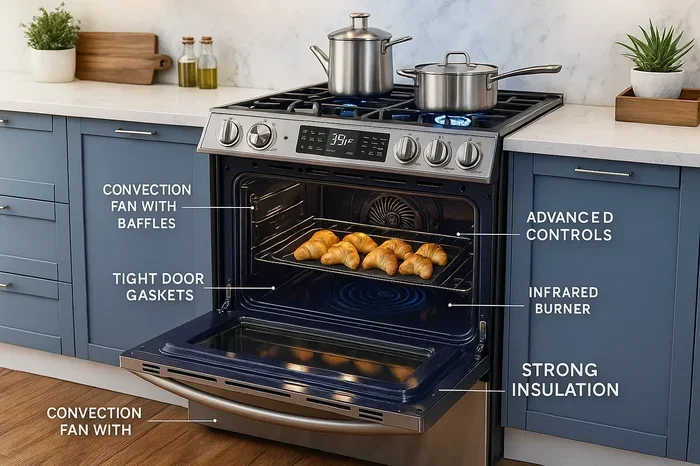
- Convection fans: Circulate hot air for faster, more even cooking.
- Energy Star certification: Meets strict efficiency guidelines set by the EPA.
- Smart temperature sensors: Adjust heat automatically to prevent overcooking.
- Double-pane oven windows: Keep heat inside and reduce kitchen warmth.
- Quick preheat technology: Reaches temperature faster, saving preheat energy.
- Indicator lights: Show when the oven has reached target temperature so you do not waste energy waiting.
Choosing an energy-efficient oven can cut your cooking energy use by 20 to 30 percent compared to older models. The upfront cost is higher, but the savings on your energy bill pay for the difference over time.
How Cooking Habits Affect Your Energy Bill
Your daily cooking routine has a bigger impact on energy costs than you might think. A few shifts in habits can make a real difference.
Use the oven only when it is truly the best tool for the job. A microwave, slow cooker, or air fryer often uses far less energy than a full oven. For reheating leftovers, a microwave uses about 0.1 kW compared to 2.5 kW or more for an oven. Choosing the right appliance for each task is one of the easiest ways to save.
Also, match your cookware to the oven size. Using a small pan in a large oven wastes energy because the oven heats more air than needed. Choose the right pan size and position it for optimal airflow. These small decisions compound into significant energy savings over a year.
Final Thoughts on Reducing Oven Energy Costs
Now you know exactly how many kW does a oven use and what you can do about it. From skipping preheat to using convection settings, every tip in this guide helps you cook smarter and spend less. The best part is that none of these changes require giving up the meals you love.
Start with one or two tips that feel easy to adopt. Once those become habits, add more. Over time, you will see a noticeable drop in your energy bill. Your wallet and the planet will both thank you.
The path to lower energy costs starts with awareness. You have that awareness now. Use it, share it, and watch your savings grow one meal at a time.
Frequently Asked Questions
How much does it cost to run an oven for one hour?
It depends on your oven’s power draw and your electricity rate. A standard 3.0 kW electric oven running for one hour at $0.15 per kWh costs about $0.45. Gas ovens cost less per hour, typically $0.20 to $0.40 depending on local gas prices. Always check your specific rates for the most accurate cost estimate.
Does using the convection setting save energy?
Yes, convection ovens cook faster and at lower temperatures, which reduces total energy use. You can lower the temperature by about 25 degrees and shorten cook times. This makes convection one of the best settings for saving energy without sacrificing food quality.
Is it cheaper to use a toaster oven instead of a full-size oven?
Absolutely. A toaster oven uses only 0.8 to 1.5 kW compared to 2.5 to 5.0 kW for a full-size oven. For small meals, reheating, and quick tasks, a toaster oven is far more energy-efficient and costs less to operate.
Should I preheat my oven for every recipe?
No, not every recipe needs preheating. Long-cook dishes like roasts and casseroles can go into a cold oven. Save preheating for baked goods and items that rely on a burst of initial heat for proper texture and rise.
How can I reduce my oven’s electricity bill?
Start by skipping preheat when possible, keeping the door closed, using convection settings, and batch cooking. Clean your oven regularly and use the right rack position. Switch to a toaster oven for small tasks. These simple changes can cut oven energy use by 20 to 40 percent.
Does a gas oven use electricity?
Yes, but very little. A gas oven uses electricity mainly for the igniter and clock, drawing less than 0.1 kW. The bulk of the cost comes from natural gas or propane, not electricity. So gas ovens have a lower electric bill impact than full-size electric ovens.
=== CONCLUSION ===
Understanding how many kW does a oven use gives you the power to take control of your kitchen energy costs. A standard electric oven uses 2.0 to 5.0 kW per hour, and that number can climb depending on how you cook. But now you have the knowledge and tools to cut those costs significantly.
From skipping preheat and using convection settings to batch cooking and switching to a toaster oven for small tasks, every change adds up. Clean your oven regularly, keep the door closed, and track your usage with an energy meter. These habits are simple, free, and effective.
The best way to save is to start small and build momentum. Pick two or three tips from this guide and try them this week. You will see the difference on your next electricity bill. Cutting oven energy use is not about sacrificing great food. It is about cooking smarter, saving money, and making your kitchen more efficient every single day.