How Long To Bake Skewers In Oven For Perfect Results
Baking skewers in the oven typically takes 15 to 25 minutes at 400°F to 425°F, depending on the ingredients and skewer type. Thin vegetable skewers may be done in 10 to 15 minutes, while meat-based skewers need 20 to 30 minutes for safe internal temperatures. This guide walks you through every step for perfectly baked skewers with minimal effort.
Key Takeaways
- Ideal Temperature: Bake skewers at 400°F to 425°F for even cooking and great browning.
- Timing Varies: Vegetable skewers take 10 to 15 minutes, while meat skewers need 20 to 30 minutes.
- Soak Wooden Skewers: Always soak bamboo skewers for 30 minutes to prevent burning.
- Flip Halfway: Turn skewers midway through baking for uniform char and doneness.
- Use a Thermometer: Check internal meat temperature to ensure safety and perfect texture.
- Line the Pan: Use foil or parchment for easy cleanup and even heat distribution.
- Rest Before Serving: Let skewers rest for 3 to 5 minutes after baking for juicier results.
📑 Table of Contents
- How Long To Bake Skewers In Oven For Perfect Results
- Why Bake Skewers In The Oven
- Best Oven Temperature For Baking Skewers
- How Long To Bake Skewers In Oven By Ingredient
- Step By Step Guide To Baking Skewers In The Oven
- Common Mistakes To Avoid When Baking Skewers
- Pro Tips For Perfectly Baked Skewers
- Delicious Skewer Recipes To Try
- Frequently Asked Questions
- Conclusion
How Long To Bake Skewers In Oven For Perfect Results
There is something magical about oven-baked skewers. They look impressive, they taste incredible, and they are surprisingly easy to make. Whether you are preparing chicken kebabs, veggie-loaded skewers, or even fruit skewers for dessert, knowing the right bake time and temperature makes all the difference.
Many home cooks worry about skewer baking time. Will the vegetables burn? Is the chicken cooked through? The good news is that once you understand a few simple principles, baking skewers in the oven becomes almost foolproof. This guide gives you everything you need, from timing and temperature to ingredient prep and serving ideas.
You will learn the exact minutes for different ingredients, the best oven temperature for skewers, and plenty of pro tips that elevate your results. Let us dive in and make your next batch of oven-baked skewers the best one yet.
Why Bake Skewers In The Oven
You might wonder why you should bother baking skewers in the oven instead of grilling. The truth is, oven-baked skewers offer some real advantages. They are convenient, consistent, and work great year-round regardless of the weather outside.
Oven baking provides even heat circulation around the skewers. Unlike a grill where hot spots can cause uneven cooking, your oven surrounds each skewer with consistent warmth. This means perfectly cooked kebabs every single time.
Another big plus is cleanup. When you bake skewers on a sheet pan lined with foil or parchment, most of the mess stays on the liner. No scrubbing grill grates. No dealing with flare-ups. Just pop the pan in the oven and let it do the work for you.
Oven baking also gives you excellent control. You can set a precise bake temperature and timer, which is especially helpful when you are cooking for a crowd. You can fit multiple skewers on a single sheet pan, making meal prep faster and more efficient.
Oven-Baked Skewers vs Grill Skewers
Grilled skewers have that classic smoky flavor that is hard to beat. But oven-baked skewers come close, especially if you finish them under the broiler for a couple of minutes. The oven method also works better for delicate ingredients like shrimp skewers or fruit skewers that might fall apart on a grill.
For busy weeknights, baking skewers in the oven is often the faster and simpler option. No need to fire up the grill, wait for charcoal, or deal with outdoor setup. You can have dinner on the table in under 30 minutes using your kitchen oven.
Best Oven Temperature For Baking Skewers
The ideal oven temperature for skewers falls between 400°F and 425°F. This range provides enough heat to sear the outside of your ingredients while cooking the inside through evenly. Too low, and your skewers will dry out. Too high, and the outside burns before the center cooks.
Here is a quick breakdown of bake temperatures for different skewer types:
- Meat Skewers (Chicken, Beef, Pork): 400°F to 425°F
- Seafood Skewers (Shrimp, Fish, Scallops): 400°F to 425°F
- Vegetable Skewers: 400°F to 425°F
- Mixed Skewers (Meat and Veg): 400°F to 425°F
- Fruit Skewers (Dessert): 375°F to 400°F
At 400°F to 425°F, most skewers finish within 15 to 30 minutes. This medium-high heat creates beautiful charred edges without overcooking the interior. Always preheat your oven for at least 10 to 15 minutes before placing skewers inside. A fully heated oven ensures consistent bake results from the start.
If you are using a convection oven, reduce the temperature by about 25°F. The fan circulates hot air more efficiently, so convection baking can shorten your skewer bake time slightly.
How Long To Bake Skewers In Oven By Ingredient
This is the section most people care about the most. The bake time for skewers depends heavily on what is on them. Thin vegetables cook fast. Dense meats take longer. Seafood falls somewhere in between. Let us break it down by ingredient type.
Baking Chicken Skewers
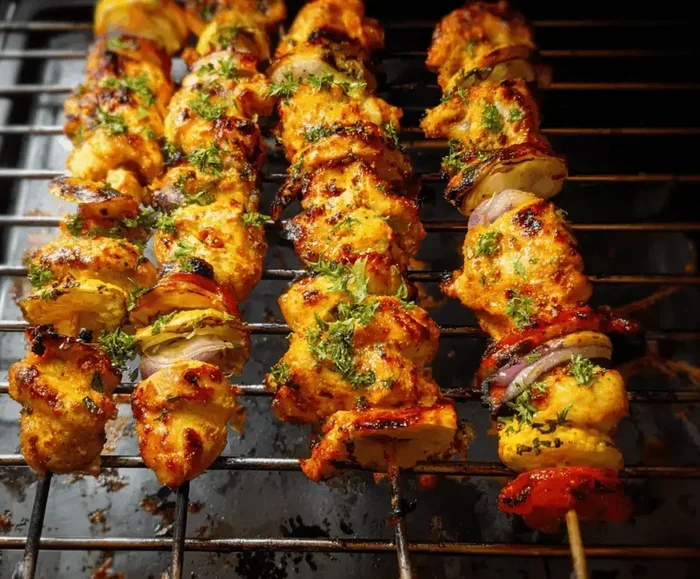
Chicken kebabs are one of the most popular skewer recipes, and for good reason. They are flavorful, filling, and incredibly versatile. When you bake chicken skewers in the oven, plan for about 20 to 30 minutes at 400°F to 425°F.
The exact chicken skewer bake time depends on a few factors:
- Size of chicken pieces: Smaller cubes cook faster, around 18 to 22 minutes.
- Thickness of pieces: Thicker chunks may need the full 30 minutes.
- Bone-in vs boneless: Boneless chicken cooks more evenly and faster.
- Marinated vs plain: Marinade does not significantly change bake time but adds flavor.
The most important thing is reaching a safe internal temperature of 165°F for chicken. Use a quick-read meat thermometer inserted into the thickest piece. This is the single best way to guarantee perfectly cooked chicken skewers every time.
If you want to compare, how long do chicken kebabs take in the oven is a common question, and the answer is generally 20 to 30 minutes at 400°F. This aligns perfectly with our bake time recommendations above.
Baking Beef and Pork Skewers
Beef and pork skewers follow a similar timeline to chicken. Beef skewers with tender cuts like sirloin or tenderloin take about 15 to 25 minutes at 400°F to 425°F. Pork skewers need slightly longer, around 20 to 30 minutes.
The key difference is in internal temperature:
- Beef: 135°F for medium-rare, 145°F for medium, 160°F for well-done
- Pork: 145°F minimum for food safety
Remember that residual heat continues cooking your skewers after you remove them from the oven. Let them rest on the pan for 3 to 5 minutes before serving. This resting period allows juices to redistribute, making every bite more flavorful.
Baking Vegetable Skewers
Vegetable skewers are the quickest to bake. Most veggie skewers are done in just 10 to 15 minutes at 400°F to 425°F. The high heat caramelizes the natural sugars in vegetables, creating sweet, charred flavors that are absolutely delicious.
Here is a general guide for vegetable bake times:
- Bell peppers and onions: 10 to 12 minutes
- Zucchini and yellow squash: 8 to 12 minutes
- Mushrooms: 8 to 10 minutes
- Cherry tomatoes: 8 to 10 minutes
- Eggplant: 12 to 15 minutes
- Potatoes (pre-cooked): 10 to 15 minutes
Harder vegetables like potatoes and carrots benefit from a quick par-boil or microwave before skewering. This ensures they cook through at the same rate as softer vegetables. Without pre-cooking, dense vegetables might stay raw in the center even after 20 minutes in the oven.
Baking Seafood Skewers
Seafood skewers are elegant and fast to prepare. Shrimp skewers bake in just 8 to 12 minutes at 400°F to 425°F. Fish skewers with firm fish like salmon or tuna need about 10 to 15 minutes.
Seafood cooks quickly, so watch your skewers closely. Overcooked shrimp become rubbery and tough. The shrimp should turn pink and opaque with slight charred edges. For fish, the flesh should flake easily with a fork but still remain moist.
If you are making oyster skewers or any seafood with shellfish, remember that cooking times differ for each type. You can find specific guidance on how long to cook oysters in the oven to get the timing just right for shellfish-based skewers.
Step By Step Guide To Baking Skewers In The Oven
Now that you know the temperatures and times, let us walk through the full process. Following these steps guarantees perfectly baked skewers every time.
Step 1: Choose Your Skewers
Start by selecting the right skewers. Metal skewers are reusable, conduct heat well, and do not need soaking. Bamboo or wooden skewers are affordable and disposable but require preparation.
If you use bamboo skewers, soak them in water for at least 30 minutes before using. This simple step prevents them from burning or catching fire in the hot oven. You can also soak them in water, broth, or even wine for extra flavor.
Step 2: Prep Your Ingredients
Cut your ingredients into uniform pieces. This is the secret to even skewer baking. If some pieces are much larger than others, they will cook at different rates. Smaller, evenly sized pieces ensure everything finishes at the same time.
For meat skewers, aim for pieces about 1 to 1.5 inches thick. For vegetables, cut them into chunks that are roughly the same size as the meat pieces. This balance helps the entire skewer cook evenly.
Marinate your ingredients if desired. A simple mix of olive oil, garlic, herbs, salt, and pepper works beautifully for almost any skewer combination. Marinating for 30 minutes to 2 hours adds tremendous flavor without much effort.
Step 3: Assemble the Skewers
Thread your ingredients onto the skewers, leaving a small gap between each piece. This gap allows hot air to circulate around the food, promoting even browning and cooking. Do not pack the skewers too tightly.
For mixed skewers with meat and vegetables, alternate the ingredients. This creates a visually appealing skewer and ensures a balanced bite every time.
Step 4: Preheat and Prep the Pan
Preheat your oven to 400°F to 425°F. While the oven heats, line a sheet pan with foil or parchment paper. This makes cleanup a breeze and prevents sticking.
Place a wire rack on the sheet pan if you have one. The rack allows air to flow underneath the skewers, promoting even cooking on all sides. If you do not have a rack, simply arrange the skewers directly on the lined pan.
Step 5: Bake and Monitor
Place the skewers on the prepared pan and slide them into the preheated oven. Set your timer based on the ingredient guide above. Flip the skewers halfway through baking to ensure even browning on all sides.
About 5 minutes before the expected finish time, start checking for doneness. Use a meat thermometer for meat skewers. For vegetables, check with a fork. They should be tender with slight charred edges.
Step 6: Rest and Serve
Remove the skewers from the oven and let them rest for 3 to 5 minutes. This resting period is crucial. It allows the juices to settle back into the meat, making every bite more succulent and flavorful.
Serve your oven-baked skewers with a drizzle of fresh lemon juice, a sprinkle of herbs, or your favorite dipping sauce. They pair wonderfully with rice, salad, flatbread, or roasted potatoes.
Common Mistakes To Avoid When Baking Skewers
Even experienced cooks make mistakes with oven-baked skewers. Here are the most common errors and how to avoid them.
- Skipping the soak: Forgetting to soak bamboo skewers leads to burning. Always soak for at least 30 minutes.
- Overcrowding the pan: Packing skewers too close together blocks hot air circulation and causes uneven cooking.
- Skipping the flip: Not turning skewers halfway through results in one side getting overly charred while the other stays pale.
- Wrong oven temperature: Too low and your skewers dry out. Too high and the outside burns before the inside cooks.
- Not using a thermometer: Guessing doneness is risky, especially with chicken and pork. Always verify with a meat thermometer.
- Ignoring rest time: Cutting into skewers immediately causes juices to run out, leaving the meat dry and less flavorful.
Avoiding these simple mistakes will take your baked skewers from average to restaurant quality. Each tip addresses a common pitfall that can ruin an otherwise perfect batch of oven-baked skewers.
Pro Tips For Perfectly Baked Skewers
Take your skewer baking game to the next level with these expert-backed tips.
Tip 1: Use metal skewers for meat. Metal conducts heat better than bamboo, which means faster and more even cooking. You can also find flat metal skewers that prevent ingredients from spinning, making them easier to flip.
Tip 2: Brush with oil halfway through. A light coat of olive oil applied mid-bake adds shine and helps achieve a beautiful golden-brown finish. It also prevents ingredients from sticking to the skewer.
Tip 3: Add a finishing salt. Sprinkle flaky sea salt or finishing salt on your skewers right after they come out of the oven. The burst of salt on warm food creates an incredible flavor contrast.
Tip 4: Use the broiler for extra char. If you want more grill-like char marks, place your skewers under the broiler for 1 to 2 minutes after baking. Watch them closely to prevent burning.
Tip 5: Batch bake for parties. You can bake multiple sheet pans of skewers at once. Just make sure there is enough space between skewers on each pan for proper air circulation. Rotate pans halfway through if baking more than one.
Tip 6: Save leftover skewers. Baked skewers reheat well in the oven at 350°F for 5 to 8 minutes. They also make fantastic additions to grain bowls, wraps, and salads the next day.
Delicious Skewer Recipes To Try
Now that you know exactly how long to bake skewers in the oven, it is time to put that knowledge to work. Here are some inspiring skewer ideas to try this week.
Classic Chicken Greek Kebabs: Marinate chicken in olive oil, lemon, oregano, and garlic. Bake for 22 to 25 minutes at 425°F with bell peppers and red onion. Serve with tzatziki sauce and warm pita.
Honey Garlic Shrimp Skewers: Toss shrimp in a sweet garlic glaze and bake for 10 to 12 minutes at 400°F. Garnish with fresh parsley and a squeeze of lime.
Mediterranean Veggie Skewers: Thread zucchini, cherry tomatoes, mushrooms, and eggplant onto skewers. Bake for 12 to 15 minutes at 425°F. Drizzle with balsamic glaze before serving.
BBQ Beef and Pineapple Skewers: Alternate beef chunks with pineapple pieces. Bake for 20 to 25 minutes at 400°F. The pineapple caramelizes beautifully in the oven.
Each of these recipes takes advantage of the oven-baking method we have covered. Adjust the bake time based on the ingredients you use, and you will have a delicious meal ready in under 30 minutes.
Frequently Asked Questions
Can you bake skewers on a regular baking sheet?
Yes, you can absolutely bake skewers on a regular baking sheet. Line the sheet with foil or parchment for easy cleanup. If possible, use a wire rack placed on top of the sheet pan. The rack promotes better air circulation around the skewers, resulting in more even browning and cooking.
Do you need to soak wooden skewers before baking?
Yes, always soak bamboo and wooden skewers for at least 30 minutes before baking them in the oven. Soaking prevents the skewers from burning or catching fire under high oven heat. You can soak them in plain water, or for extra flavor, try soaking in broth, wine, or fruit juice.
Can you reuse metal skewers after baking?
Absolutely. Metal skewers are reusable and durable. After baking, let them cool, then wash them with warm soapy water. Most metal skewers are dishwasher safe as well. They are a worthwhile investment if you bake skewers regularly.
What is the best way to check if skewers are done?
The most reliable method is using a meat thermometer. For chicken, check that the internal temperature reaches 165°F. For beef, aim for your preferred doneness level. For vegetables, check that they are tender when pierced with a fork. Visual cues like golden-brown edges and slight charring also indicate doneness.
Can you bake frozen ingredients on skewers?
You can, but it is not ideal. Frozen ingredients release excess moisture during baking, which can steam instead of roast. For the best results, thaw your ingredients first and pat them dry before threading onto skewers. This ensures a better bake and more even cooking. If you must bake from frozen, add 5 to 10 extra minutes to the bake time and check for doneness frequently.
How do you prevent vegetables from falling off skewers?
To keep vegetables secure on skewers, cut them into larger, thicker pieces that fit snugly between the holes. For soft vegetables like tomatoes or mushrooms, use metal skewers which hold food more firmly. You can also double-thread vegetables, pushing them through twice on the skewer to create a more secure hold.
Conclusion
Baking skewers in the oven is one of the easiest and most rewarding ways to prepare a delicious meal. With the right temperature, timing, and technique, you can create restaurant-quality kebabs in your own kitchen. Whether you are making chicken, beef, seafood, or vegetable skewers, the principles remain the same: 400°F to 425°F, 10 to 30 minutes depending on ingredients, and always check for doneness.
Remember to soak wooden skewers, flip halfway through, and let your skewers rest before serving. These small steps make a huge difference in the final result. Use a meat thermometer for safety and perfection every time.
Now that you have all the timing, temperature, and pro tips, it is time to fire up your oven and start baking. Grab your favorite ingredients, thread them onto skewers, and enjoy the incredible flavors of perfectly oven-baked skewers. Your taste buds will thank you.